I recently procured a new vinyl pressing of the third-eye-opening Shri Camel (1980), a landmark composition by the Grandfather of Electronic Music, Terry Riley, and had some friends over to listen to the masterpiece. (Side note: be sure to check out his amazing web 1.0 website.)
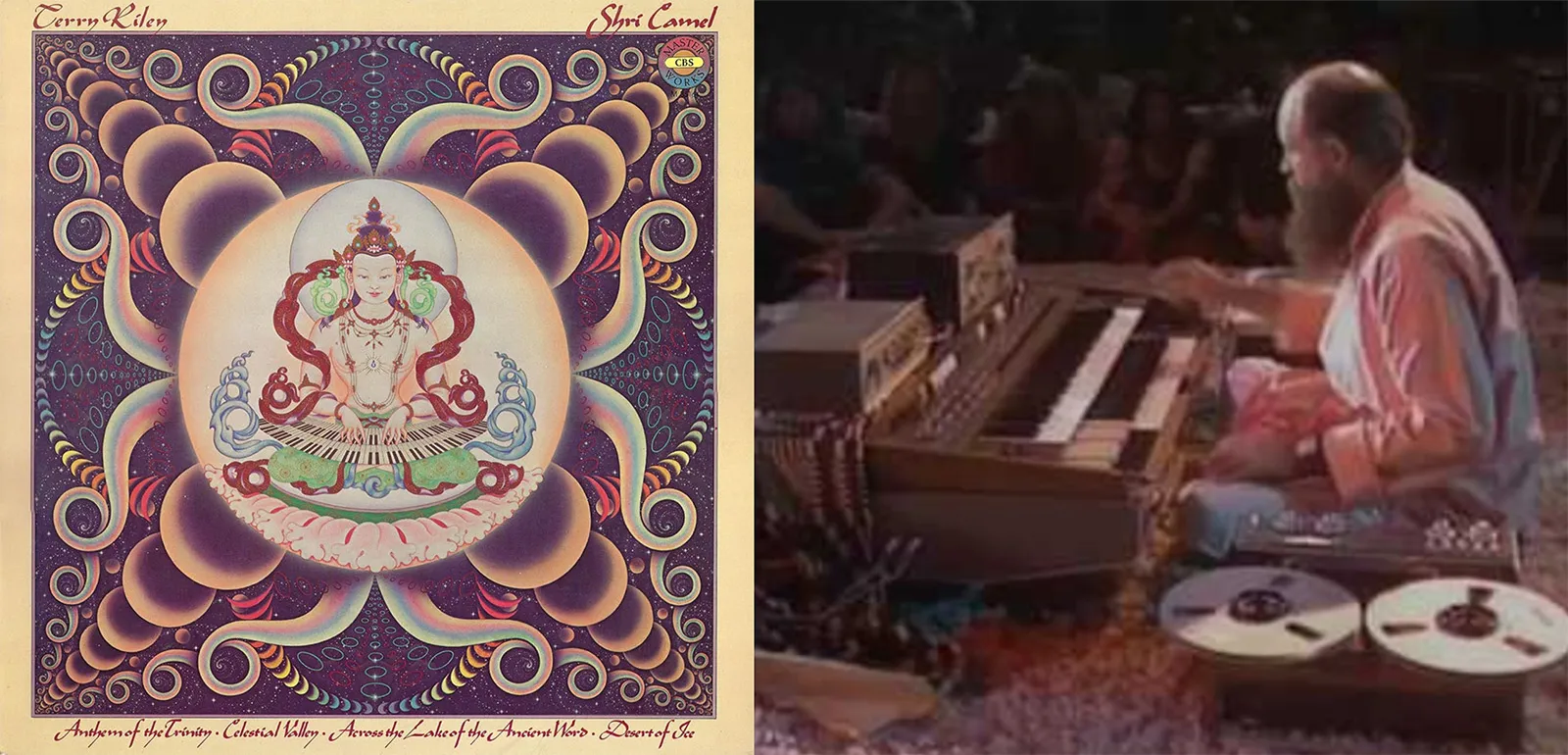
The last in a triptych of albums he recorded for CBS Records, Shri Camel is the culmination of improvisational experiments with electronic keyboards and tape loops that Riley began conducting in live settings as early as the 1950s. The version of the piece captured on the record was at least five years in the making and is likely never to be performed in the same way again (although, incidentally, his son Gyan performed an arrangement of Riley’s earlier Rainbow in Curved Air at the Ford Theater in September, in honor of Terry’s 90th birthday.) The piece is the crystallization of avant-garde compositional techniques, San Francisco bohemianism, LSD, and the music and philosophies of the Indian subcontinent. (Shri is a Sanskrit honorific. Camel is… a camel?)
While this combination and era of music is often presented under the amorphous term of “minimalism,” that term feels particularly inadequate when applied to Riley, as anyone who is familiar with the extravagance of In C can attest. This is because Riley’s music strains the boundaries traditionally set by Western music. In Shri Camel, from the braying fanfare of Riley’s justly tuned* Yamaha organ at the piece’s start to the endlessly evolving melodic textures that emerge later on, we find ourselves in a shifting aural landscape variously reminiscent of early medieval instrumental forms (think shawms and sackbuts), mictotonal Indian ragas, and even hard bop.
(*If you want to go down a music nerd’s rabbit hole, check out the Wikipedia entry for just intonation; the quick summary is that it uses simple ratios for the intervals between notes, giving the instrument’s sound a more raw, mictrotonal feel than modern Western tuning—which in its “equal tempered” philosophy mathematically evens out the distances between intervals.)
The simple repetitions and drones typical of minimalism are evident throughout Riley’s work, of course, but the overall effect in Shri Camel is rather one of maximal sonic effusiveness, rather than the cold emptiness evoked by academic composition. Individual notes seem uninterested in the concept of “precision,” leading to a constant wave of crunchy dissonances that chafe against the pop sensibilities our ears are accustomed to. But the piece as a whole still manages to be consonant and incredibly melodic.
Riley’s virtuosic solo performance transcends individuality; it is often hard to believe that the ecstatic glossolalia pouring forth from the refracted organ loops is the product of one mind and set of hands (with no digital effects!!), and not the angelic babbling of a host of divinities—an effect that is further enhanced by esoteric track titles such as “Anthem of the Trinity” and “Across the Lake of the Ancient World.” An objective sense of multitudinousness is what Shri Camel most imparts to the listener.