We live in a profoundly connected world. This is not a world any of us chose to inherit; its present, disfigured shape has been molded by centuries of inertia set in motion by violence and accident, intentional and unintentional choice, structural oppression and human error. The world system built on the foundation of colonialism, slavery, capitalism, and environmental destruction is a constantly amassing economic, political, and social glacier from which no individual or place is exempt. This is the world we all inherit, a world buckling under the uneven distribution of advantage over time.
The question of how we got here is crucial, both for understanding the interconnected present and its myriad problems and related injustices, and for clarifying the substance of a future world that aims to set things right. But too often this process is beset by a glaring historical amnesia. At least in American discourse, we tend to believe that our problems are recently made, or, even worse, that there are no problems which have not already solved themselves or that are in the process of doing so. This amnesia is just as evident in the conservative backlash over the teaching of racial history in schools as it is in techno-utopian schemes to solve the climate crisis by means of resource-intensive consumption.
Against such entrenched amnesia, a “long view” of the present system would focus on its historical birth and making, its build-up from contingent elements that have solidified over time into a mass of global inequality. A long view would also demand that present efforts aimed at reparations to right the unjust structures we inherit be nothing less than worldmaking projects in their own right. Rather than seeing reparations as a one-time act that magically settles a one-time score—an act conducive to further amnesia—reparations ought to be focused on a comprehensive transformation of our received reality. This transformation necessarily pulls from the past just as it extends into the future in an ongoing struggle for justice on behalf of humans and non-humans alike.
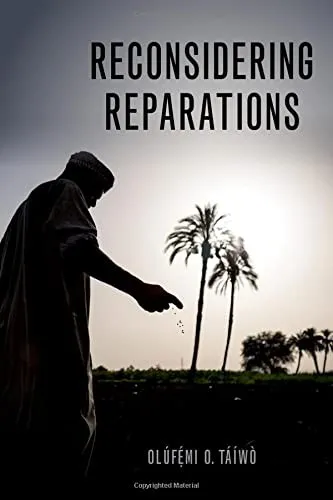
Reconsidering Reparations
Shelves: Decolonization, Political Economy, Political Theory, Social Change
This shift in focus is exactly what philosopher Olúfẹ́mi Táíwò accomplishes in Reconsidering Reparations (Oxford University Press, 2022), a persuasive book that reframes reparations for colonialism and slavery as a global “construction project.” Importantly, this project is one that pays particular attention to climate justice—arguably the most important future-oriented task we face today. In this general outlook, Reconsidering Reparations forms part of a larger movement on the left linking the long view of historical injustice to contemporary racial and climate justice.
Global movements for a People’s Green New Deal, worldwide calls for Land Back and Indigenous self-determination, and analyses linking white supremacy to capitalism’s plunder of labor and nature all point to this same idea: the world built on the brutal exploitation of the colonized, the enslaved, and the land itself is a world that continues to disadvantage Black people, Indigenous people, and peoples of the Global South. It is also a world that is destroying the planet we know. As Táíwò writes:
Climate justice and reparations are the same project: the climate crisis arises from the same political history as racial injustice and presents a challenge of the same scale and scope. The transformations we succeed or fail to make in the face of the climate crisis will be decisive for the project of racial justice, and vice versa. (149)
Táíwò names the unjust world system we have inherited the “Global Racial Empire.” The chapter devoted to narrating its features (“Reconsidering World History”) is a masterful exercise in understanding history not as a series of isolated events but as an interconnected totality with objective ramifications for the present. As in Marx’s famous line, humans “make their own history, but they do not make it as they please,” constrained as we are by past circumstances with tangled and determinant implications for our future actions.
Táíwò’s starting point naturally owes much to the radical writers and movements that identify the trans-Atlantic slave trade and the genocidal colonial project as an inseparable part of modern “progress”—from Black liberationists to Latin American dependency theorists to the anti-colonialists who forged the identity of “Third World” in the 1960s. But Táíwò offers a compelling addition to this narrative by focusing on how Global Racial Empire is always imperceptibly in motion, constantly building up “cumulative advantage and disadvantage” on a global scale.
Framing the problem in this way allows us to see how the “compounding inertia of unequal and uneven trajectories of accumulation” from centuries past can explain present injustice. The same historical determinants responsible for the stark divide in wealth and resources between the Global North and Global South effect a disproportionate level of disadvantage on Black and Indigenous people in the United States. The global flow of labor and value still follows the same outline set half of a millennium ago.
Moreover, Táíwò’s focus on “cumulative advantage” is part of a deeper philosophical engagement with what justice and reparations really ought to be, which he develops through concrete examples reinforced with social science. Unlike some prevailing notions of justice—such as the liberal Rawlsian, which, Táíwò argues, operates statically on a “snapshot view” of present inequality—Táíwò’s “constructive” framework is attuned to the dynamic distribution of capabilities for people to live meaningful lives. Any project of reparations, Táíwò suggests, is limited if it does not adopt this capacious foundation:
A worldmaking perspective endows us with the mission, not simply of distributing ‘stuff’ in order for everyone to have equal amounts of it, but rather of creating a world where the variations we are born with are all socially translated into lives rich in capabilities. (93)
One of the most striking things about this approach is that it sidelines the moral motivations for reparations which often underpin its discussion in favor of a target focused on material outcomes—a world remade for a more just distribution of capabilities. Táíwò is not interested in legal victim-victimizer binaries, especially when they are used to assign causal responsibility for Global Racial Empire to contemporary identity groups. It makes little sense, Táíwò argues, to approach reparations by exclusively blaming white people or the Global North for their complicity in past wrongs, or by treating the marginalized as uniquely deserving of recompense.
Although the role of whiteness and European capitalism is closely bound up with the inertia and enormity of Global Racial Empire, the oversimplification of the binary view defuses what should be a forward-looking construction project. It reduces to the level of the individualistic what is properly a collective worldmaking effort aimed at transforming the shape of the present system.
However, as Táíwò writes, the Global North should bear more of the burden of rebuilding this world—not because of an inherent moral responsibility, but “because of the relationship that their advantages hold to that history.” (124) This is especially true in the case of climate justice. The notion of a “climate debt” owed to the Global South calls attention to the fact that the Global North has contributed a vastly greater amount damage to the climate at the expense of Global South nations, precisely because of the centuries-long flow of resources and wealth from South to North that is a direct legacy of colonization. Thus, some form of redistribution of the burden of global climate change must be part of any worldmaking reparations project.
Reparations built on a foundation beyond the moral is an important lesson for Christian responses to Global Racial Empire. Táíwò situates his constructive view as distinct from both “harm repair” and “relationship repair” models of reparations—those focusing on restitution or reconciliation. Both, of course, have a key part to play in reparations, but when they take priority over worldmaking, Táíwò suggests, we are left with a weak tool for actually accomplishing change.
It is easy for Christianity to default unintentionally to either of these models of justice rather than to one based on forward-looking construction. The causal, binary morality of sinner/saved, evil/innocent, damned/redeemed lends itself readily to an exclusively backward-looking harm reduction view that enshrines these categories as unchanging essences—and that places primary focus on punishment and individual guilt for wrongdoing.
This outlook, which has formed the basis of many an imperialist and racist theology, is itself part of the destructive legacy of Christianity’s participation in Global Racial Empire. Adopting a constructive approach to reparations would not let Christianity off the hook for its historic and ongoing participation in structures of oppression, but it would enable Christian responses to move past symbolic gestures that largely leave the realm of future transformation—what we are fighting for—untouched.
Moreover, a constructive approach necessarily entails a respect for self-determination among disadvantaged peoples and nations. As the historian Vine Deloria, Jr. quipped in 1969 book Custer Died for Your Sins, “The primary goal and need of Indians today is not for someone to feel sorry for us … what we need is a cultural leave-us-alone agreement.” Sometimes the best way to reduce harm is to get out of the way and join in-place struggles for justice in a spirit of humility—a lesson best modeled by the liberationist Christianities that have grown out of the Global South.
Similarly, Christian attempts at racial or social reconciliation are often too eager to reconcile without doing the hard work of understanding history, assessing the depth and complexity of current injustices, and taking material steps to build a more just world. All of these processes are necessary if reparations are to be constructive. Redemption is an end point that many Christians want too quickly; it means little without the accompanying weight of a substantive commitment to class struggle, institutional decolonization, and the dismantling of injustice. In the face of the realities of Global Racial Empire, we may wish we are the unified body of Christ, but unity comes not by declaration but by the actions taken to remake a more just world.
This brings us again to the issue of climate justice. Simply put, climate justice matters for reparations because of how the disproportionate effects of ecological change alter the capabilities of many people to live rich lives. As is evident from the last few decades—Táíwò focuses on the harrowing structural racist after-effects of Hurricane Katrina, but there are no shortage of examples—“climate change is set not just to redistribute social advantages, but to do so in a way that compounds and locks in the distributional injustices we’ve inherited from history.” (171) The fact that we are already moving to a global “climate apartheid” is an urgent signal that climate justice be considered an integral part of global reparations.
Global Racial Empire constrains life for all of us, not just the most marginalized—and, I would add, for all organisms beyond the human. If this is not a world we chose to inherit, it is a world we can choose to bend in a more just direction. This hope is not built on a false optimism, but is grounded in a radical outlook echoing the words of Dr. Martin Luther King, Jr., which Táíwò quotes: that in a burning house, we must all become firefighters.
At the end of the book, Táíwò leaves the reader with reflections on how to fight the fires of Global Racial Empire while resisting the amnesia that allows this system to continue unchecked. One such tactic that carries deeply spiritual implications is that of “acting like an ancestor.” Cultivating this attitude links us across time and space with those who have come before us and those that will come after us, to whom we now bear responsibility. Faith is the only word that describes the kind of blind commitment this outlook entails.
Against accelerationism and apocalypticism, acting like an ancestor requires a “revolutionary patience” that accepts the challenge of making small changes for a just world that may reverberate long after we are gone. There are no final, immediate solutions, and the world will not be remade only upon the condition of obliteration. We can only take up the tools we have now and start building.